
Leak Detection Services
You’ve Had Three Roofers Out. None of Them Found the Leak. We Will — and We’ll Show You Exactly Where It Is.
Thermal imaging. Electronic leak detection. Moisture mapping. We use the right diagnostic tools to pinpoint the exact source of your leak — not guess at it.
Why Patch Repairs Keep Failing
Here's something most roofers won't tell you: on a flat roof, the stain on your ceiling is almost never directly below the point where water entered the building. Water tracks horizontally — along insulation boards, under vapour control layers, through screeds — sometimes for metres before it finds a way through the deck.
That's why patch repairs so often fail. The roofer applies mastic or a patch where the water appears to be coming in. It rains again. The leak continues. Because the actual breach is somewhere else entirely.
The only way to fix a leak permanently is to find it first. That requires diagnostic tools — not guesswork.
What We Hear From Building Managers
- "We've had three roofers out and it's still leaking"
- "They patched it six months ago and it's come back"
- "Nobody can tell me where the water is actually coming from"
- "The leak only happens in certain wind directions"
- "We're getting water in but there's no obvious damage on the roof"
- "We've spent thousands on repairs and it's still not fixed"
If any of this sounds familiar, you need a proper leak investigation — not another patch.
How We Find It
Six diagnostic methods. The right tool for every roof type and build-up.
Thermal Imaging (Infrared)
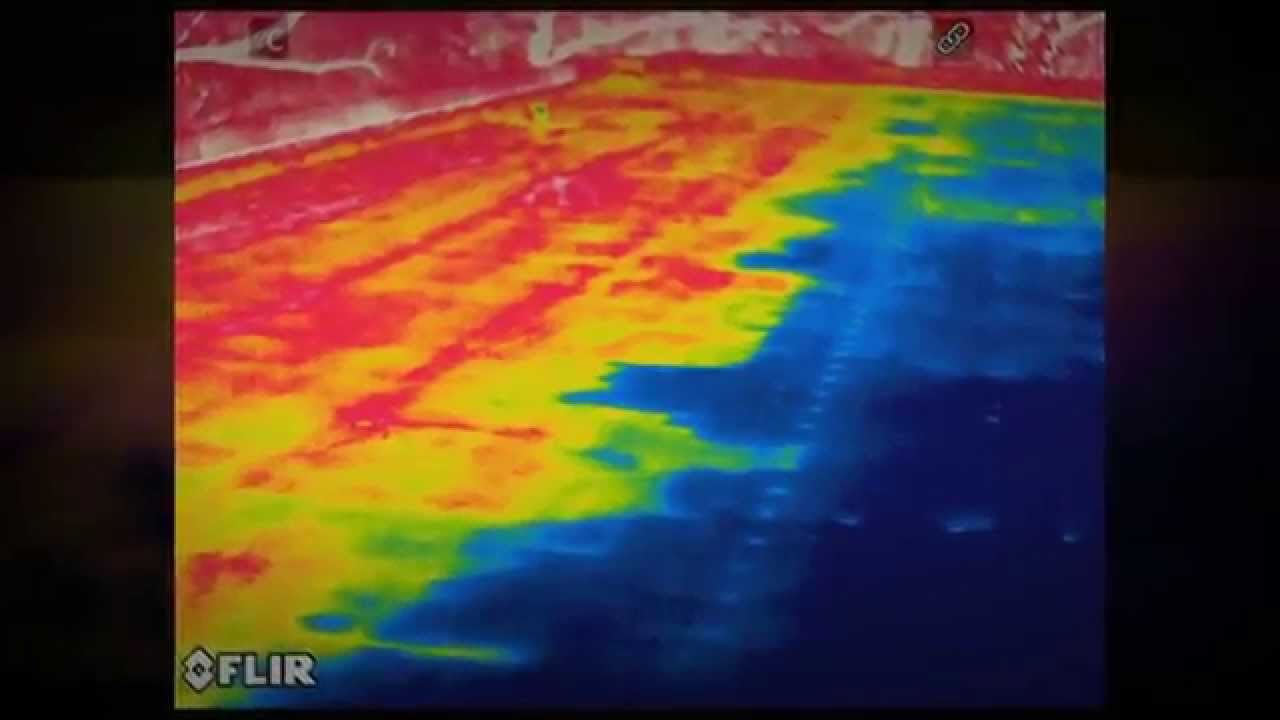
Infrared cameras detect temperature differentials caused by trapped moisture beneath the membrane. We survey at dusk when thermal contrast is highest — revealing wet insulation, hidden ponding, and saturated build-ups invisible to the naked eye.
Electronic Leak Detection (ELD)
Low-voltage electronic testing locates breaches in non-conductive membranes with pinpoint accuracy. Compliant with BS 8217 recommendations, ELD can find holes as small as 1mm — even under ballast, paving, or green roof build-ups.
Moisture Mapping
Capacitance and impedance meters create a full moisture map of your roof build-up. We grid the roof, take readings at every intersection, and produce a colour-coded map showing exactly where moisture has entered and how far it has tracked.
Core Sampling & Analysis
When we need to confirm what’s happening beneath the membrane, we take small core samples and analyse the build-up layer by layer. This tells us the insulation type, condition, moisture content, and whether the existing system can be overlaid.
Flood Testing
For accessible flat roofs, controlled flood testing remains one of the most reliable methods. We plug the outlets, flood the roof to a controlled depth, and monitor for ingress below. Simple, effective, and conclusive.
Detailed Reporting
Every investigation produces a written report with photographs, thermal images, moisture maps, and clear recommendations. You’ll know exactly what’s wrong, where it is, and what it costs to fix — no ambiguity.
Diagnose and Fix. One Company.
Most leak detection companies find the problem and hand you a report. Then you need to find a roofing contractor to actually fix it. If the repair fails, the surveyor blames the roofer. The roofer blames the surveyor. You're back to square one.
Vanguard does both. We find the leak with diagnostic precision, then we fix it with the right waterproofing system — Triflex PMMA for flat roofs and terraces, HD Sharman for metal roofs, or targeted detail repairs for isolated failures.
One company. One report. One fix. One guarantee. That's accountability.
When to Call Us
Commonly Asked Questions
Why can’t my roofer find the leak?
Because water doesn’t behave the way most people think. On a flat roof, water enters at one point and tracks horizontally — sometimes for metres — along the insulation or vapour control layer before it finds a path through the deck and drips into the building below. The stain on your ceiling could be 10 metres from the actual breach. Without diagnostic tools like thermal imaging or electronic leak detection, a roofer is essentially guessing. That’s why patch repairs so often fail — they’re fixing the symptom, not the source.
How accurate is thermal imaging for leak detection?
Very accurate when done properly. Infrared cameras detect temperature differences caused by trapped moisture — wet insulation cools at a different rate to dry insulation, creating a clear thermal signature. The key is timing: we survey at dusk or after a dry period when thermal contrast is highest. Combined with moisture mapping and visual inspection, thermal imaging typically identifies the source on the first visit.
What is electronic leak detection and when is it used?
Electronic leak detection (ELD) uses a low-voltage electrical field across the membrane surface. Water is conductive, so any breach in the membrane creates a detectable pathway. An operator with a handheld probe walks the roof, and the equipment signals when it passes over a defect. ELD is incredibly precise — it can locate holes as small as 1mm — and it’s particularly useful on single-ply and liquid-applied membranes. BS 8217 recommends it as part of quality assurance on new installations.
How much does leak detection cost?
A standard leak investigation using thermal imaging and moisture mapping typically costs £800–£2,500 depending on roof size and complexity. Electronic leak detection adds £500–£1,500 for the specific area under test. Compare that to the cost of repeated failed patch repairs, internal damage to fixtures and fittings, and business disruption. Most clients tell us they wish they’d called us first.
Can you detect leaks under paving, ballast, or green roofs?
Yes. Electronic leak detection works on membrane systems beneath ballast, paving slabs, and green roof build-ups — because it tests the membrane itself, not the surface covering. For thermal imaging, we may need to remove a section of covering to get accurate readings, but this is usually localised. We’ll advise on the best approach for your specific build-up during the initial consultation.
Do you also fix the leak once you’ve found it?
Yes. We’re not just a diagnostics company — we’re waterproofing contractors. Once we’ve identified the source, we can specify and carry out the repair using the appropriate system (Triflex PMMA, HD Sharman, or detail work). You get one company, one report, one fix — rather than paying a surveyor to find it and a roofer to fix it, with each blaming the other if it doesn’t work.